I want to tell you something that should be obvious but apparently isn’t, not to most women, not to most general practitioners, and not even to most psychiatrists.
You can be on an antidepressant that is working. Your depression is managed. You are not crying in your car. You are functioning. And you can still have a flat, motivationless quality that is real, that is specific, and that your antidepressant cannot touch, not because the medication is wrong, but because it is solving a different problem in a different system entirely.
I spent years adjusting the wrong lever, and my antidepressant was never the problem.
I was not depressed. Something was still wrong.
I have been on an antidepressant for 30 years. I’m not ashamed of this. It does what it’s supposed to do. I do not have clinical depression the way I had it before medication, the bottomless weight, the inability to see forward, the feeling that the ground had dropped out. That’s gone. Has been for decades.
What crept in through my 40s was something different. Quieter. Harder to name and easier to explain away.
Not sadness. Not inability to function. I was functioning fine. But something underneath the function was flat.
The project I’d been excited about now felt like it had a ceiling. The willingness to start things, to walk into a blank slate and feel the pull of possibility, went quiet. I used to wake up with ideas I wanted to chase. That became waking up with ideas I noted, organized, and then didn’t pursue with any particular urgency.
I thought I was becoming more realistic. I thought this was what wisdom looks like at 52. I thought the drive I’d had when I founded adoption.com in 1995, when I was running orphanages in three countries simultaneously and still had energy left over to pick fights about internet strategy, was a feature of youth, not a feature of biology. I grieved it quietly and moved on.
What I didn’t know: that flatness has a name. And it had a cause. And it wasn’t coming from the system my antidepressant was working on.
Name it first: anhedonia.
The clinical term is anhedonia. It is technically defined as the loss of pleasure or motivation in activities that previously brought pleasure or motivation, but that definition undersells it, because it makes it sound like sadness. It isn’t sadness.
🎙️ Follow Dr. Judith Joseph
Judith Joseph, MD, MBA. Columbia-trained psychiatrist and researcher who coined the term “high-functioning depression” for women who appear fine but feel flat, joyless, and unmotivated inside. She names anhedonia as a distinct clinical phenomenon, separate from depression, and gives women the language to bring it to their doctors.
“Have you been feeling kind of meh or bleh lately? That could be a sign of anhedonia, a lack of pleasure and joy in things you used to find pleasurable. Intimacy becomes a chore. You don’t feel emotions as intensely as you used to. You just kind of feel muted or dull.”
Source: Signs of anhedonia and high functioning depression · CNN segment on high-functioning depression
📸 Instagram: @dr.judithnjoseph 🌐 judithnjosephmd.com
Tamsen Fadal is not a physician. She’s a journalist and television anchor. Which is part of why her account of this specific experience hit so many women so hard. She went through it publicly, on camera, and described it in language that felt nothing like a clinical definition.
🎙️ Follow Tamsen Fadal
Tamsen Fadal. Emmy award-winning journalist and author of How to Menopause, who has spoken publicly about her own HRT experience including testosterone therapy. She reaches millions of women through the Today Show, Good Morning America, and her newsletter. Her willingness to describe her own hormone experience in personal terms has brought this conversation to women who would never have found it through medical channels.
“Somebody had just turned my volume down a little bit. My energy had been zapped. I was going through the motions of my life but not feeling any of it.”
Source: Testosterone 101: Everything You Need to Know in 20 Minutes
📸 Instagram: @tamsenfadal 🌐 tamsenfadal.com 📗 Book: How to Menopause
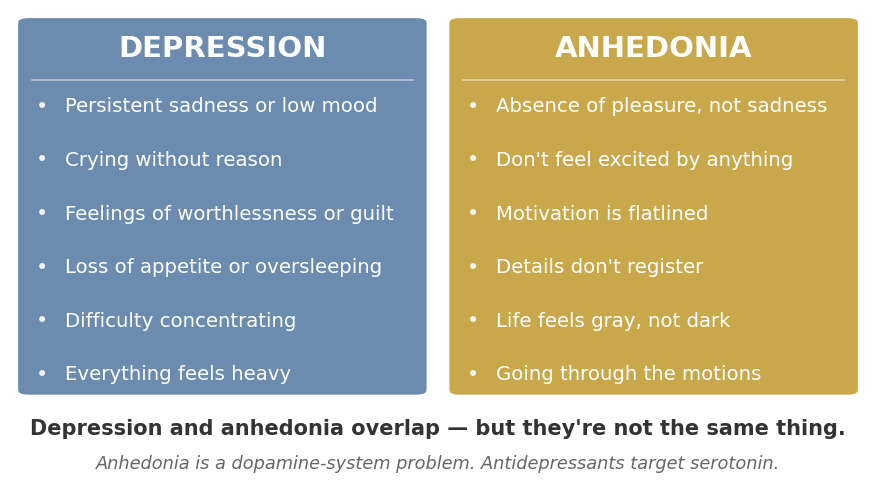 Depression and anhedonia overlap, but they’re not the same thing. Depression is the presence of pain. Anhedonia is the absence of pull. That distinction changes what you need.
Anhedonia is the loss of the pull. The wanting. The dopamine-mediated signal your brain sends that says go toward that thing, that’s worth doing. Not the ability to enjoy something once you’re doing it, the motivation to initiate. To start. To care enough to begin.
It shows up not as “I am unhappy” but as “I don’t particularly feel like it.” As a low hum of indifference where enthusiasm used to be. As the absence of the hunger to pursue things. As a quieter, more manageable version of yourself that you mistake (easily, understandably) for maturity.
Women describe this to me in almost identical language:
“I’m just less driven than I used to be.” “I’ve become more of a settler.” “I don’t start things the way I once did. I guess I’ve outgrown that.”
None of them call it anhedonia. None of them connect it to hormones. They connect it to aging. And then they move on, because there doesn’t seem to be anything to do about aging.
There is something to do. But you have to understand why first.
The two systems. The two problems.
Here is the scientific core of what I wish someone had explained to me a decade ago.
SSRIs (selective serotonin reuptake inhibitors) and SNRIs (serotonin-norepinephrine reuptake inhibitors), the most commonly prescribed antidepressants, work primarily on serotonin pathways. Serotonin regulates mood stability, emotional reactivity, anxiety. When clinical depression involves a dysregulated serotonin system, SSRIs are the right tool. They work for what they work for.
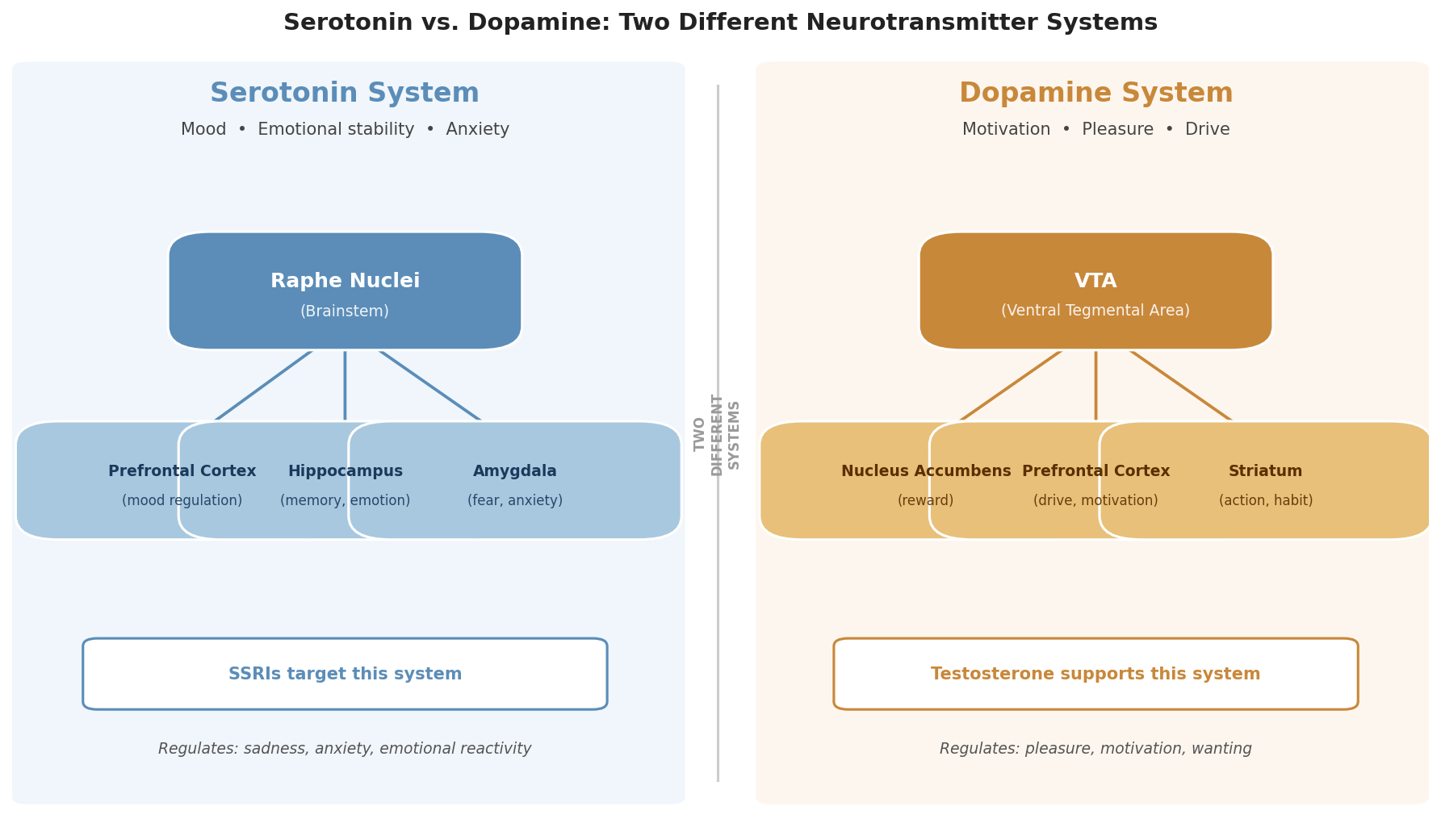 Two systems, two tools. SSRIs work the serotonin pathway (mood stability, emotional reactivity). Testosterone works the dopamine pathway (motivation, wanting, drive). Adjusting the serotonin system can’t fix a dopamine problem. They’re different circuits.
My own antidepressant is duloxetine, an SNRI that increases serotonin and norepinephrine. It’s a well-studied drug with a strong track record. What it does not do is meaningfully affect dopamine. That’s not a flaw; it wasn’t designed to. There is one commonly prescribed antidepressant that does act on the dopamine system: Wellbutrin (bupropion). I tried it. It gave me heart palpitations and I had to discontinue it. Which means I was left with the drug that handles the serotonin system, and nothing addressing the dopamine system at all. When I started testosterone, I wasn’t supplementing something I had other options for. I was filling a gap that, for cardiac reasons, I had no pharmaceutical path to fill any other way.
Testosterone-deficiency anhedonia runs through a completely different system: dopamine.
Specifically, testosterone upregulates the dopamine wanting signal in the brain through several mechanisms: it increases tyrosine hydroxylase, the enzyme that produces dopamine. It upregulates D2 and D5 dopamine receptor sensitivity. And it acts on androgen receptors in the ventral tegmental area, the origin point of the mesolimbic pathway, which is the brain’s core motivational and reward circuit. The VTA is where the limbic “wanting” signal and the prefrontal “doing” signal both originate. When testosterone is adequate, that system runs. When it drops, the signal weakens. The pull toward things dims.
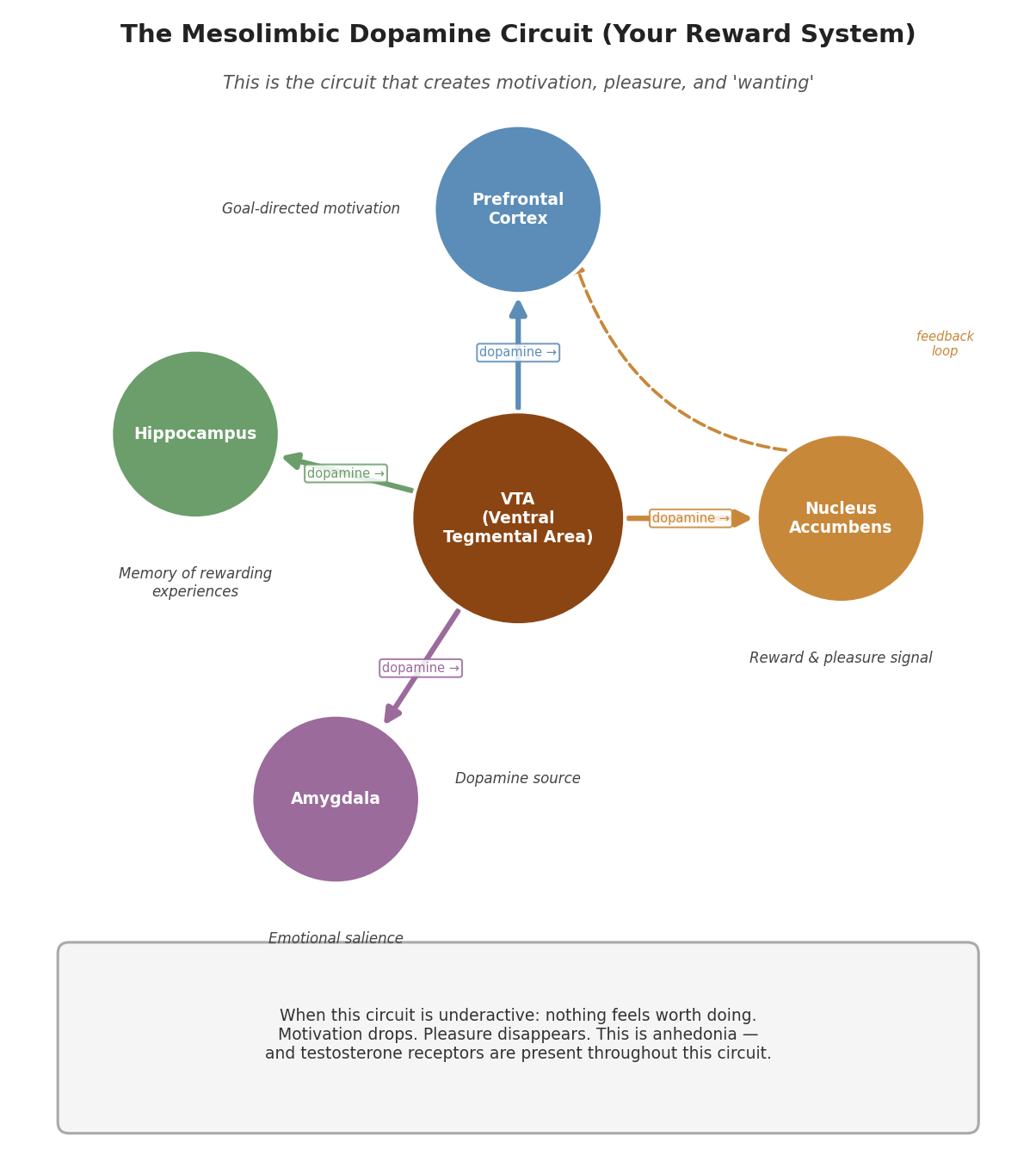 The mesolimbic pathway is your brain’s core motivation and reward circuit. The VTA (ventral tegmental area) is where the “wanting” signal originates. Testosterone acts on androgen receptors here, upregulating dopamine production and receptor sensitivity. When testosterone drops, this circuit runs quiet.
These systems are neighbors, not the same building. An antidepressant that is working perfectly on the serotonin system will not touch the dopamine system. It isn’t supposed to. It wasn’t designed to.
This is not well understood in general medicine. Women on SSRIs who report persistent flatness, loss of motivation, or diminished drive are routinely told their medication needs adjusting. Sometimes they’re switched to a different antidepressant. Sometimes they’re offered a higher dose. Sometimes they’re told this is just how things are at this stage of life. Almost never are they told: your antidepressant is working correctly, and you have a separate problem in a different system that it cannot address.
Dr. Kelly Casperson has been fighting this dismissal problem loudly for years. If you’ve ever left a doctor’s office feeling like your concerns were minimized or rerouted into a prescription you didn’t ask for, her podcast is the antidote.
🎙️ Follow Dr. Kelly Casperson
Kelly Casperson, MD. Urogynecologist, host of the You Are Not Broken podcast, and author of the book You Are Not Broken. She has argued for years for testosterone access for women, and against the specific, exasperating failure of medicine to take mood and motivation symptoms seriously as hormone symptoms.
“All right, so stop telling me testosterone doesn’t help mood. Significant increase and improvement in mood, like by around 40%… These are neurohormones. They work in the brain. They’re not just for libido. They’re not just for hot flashes. They help your brain function. And where does mood come from? Brain function.”
Source: Hormones (including testosterone) help mood
And on the history: “In 1985, a double-blind randomized controlled trial found that women randomized to testosterone had more energy, improved well-being, and greater improvements in mood scores. Don’t tell me there’s no data on testosterone and mood. That’s 40 years ago.”
Source: Testosterone: Improving Women’s Brains
📸 Instagram: @kellycaspersonmd 🎧 Podcast: youarenotbrokenpodcast.com 📗 Book: You Are Not Broken
Dr. Rachel Rubin makes the dopamine connection explicit in a way that most physicians still won’t say out loud.
🎙️ Follow Dr. Rachel Rubin
Rachel Rubin, MD. Sexual medicine specialist who has called the lack of testosterone options for women “a regulatory and equity failure.” Her work explicitly connects the testosterone-dopamine-motivation pathway to the clinical reality of women who are told their symptoms aren’t real.
“If you feel not like yourself, it’s real. I’m going to say it. It’s real. The dopamine pathways that drive motivation and desire don’t work as well when testosterone drops. Women deserve science. They don’t realize it because all they’ve ever gotten is snake oil.”
Source: Menopause, Hormones and Women’s Sexual Health with Dr. Rachel Rubin
📸 Instagram: @drrachelrubin 🌐 rachelrubinmd.com
A note on timing.
This picture doesn’t look the same at every stage. In early perimenopause, late 30s into mid-40s, still cycling but noticing changes, testosterone is fluctuating rather than uniformly declining. The flatness may come and go with your cycle rather than sitting as a constant background hum. By late perimenopause and into postmenopause, the decline becomes more consistent, and so does the signal-weakening in the dopamine pathway. If you’re earlier in the transition and the flatness is intermittent, that fits the picture. If you’re further along and it’s become a steady state, that fits too.
There’s a third group worth naming: women who had their ovaries removed, whether for endometriosis, cancer prevention, or another reason, often experience the sharpest and most sudden testosterone drop of all. Surgical menopause doesn’t taper; it stops. The motivational flatness can arrive within weeks of surgery, not months or years. If this is your situation, the timing signals in this article still apply, but your baseline was likely disrupted earlier and more abruptly than gradual menopause, which matters for how your provider interprets your labs.
The investigation is the same either way.
What the evidence shows.
The research on testosterone and anhedonia in women is not perfect. No one has ever run a randomized controlled trial with anhedonia as the primary endpoint, which is its own indictment of how seriously medicine has taken this question.
But the observational evidence is striking. A 2024 UK observational study of 510 women on testosterone therapy tracked symptom response across every category measured, and as observational data, it cannot rule out placebo response, the natural course of treatment, or healthy-user effects. With that caveat clearly on the table: of all the symptoms studied, anhedonia (“loss of interest in most things”) had the highest response rate: 56%. [Glynne et al., Archives of Women’s Mental Health, 2024] An uncontrolled study cannot prove causation. But 56% as the single most responsive symptom, in 510 women, in a peer-reviewed journal, is a signal that deserves the adequately powered trial it has never received.
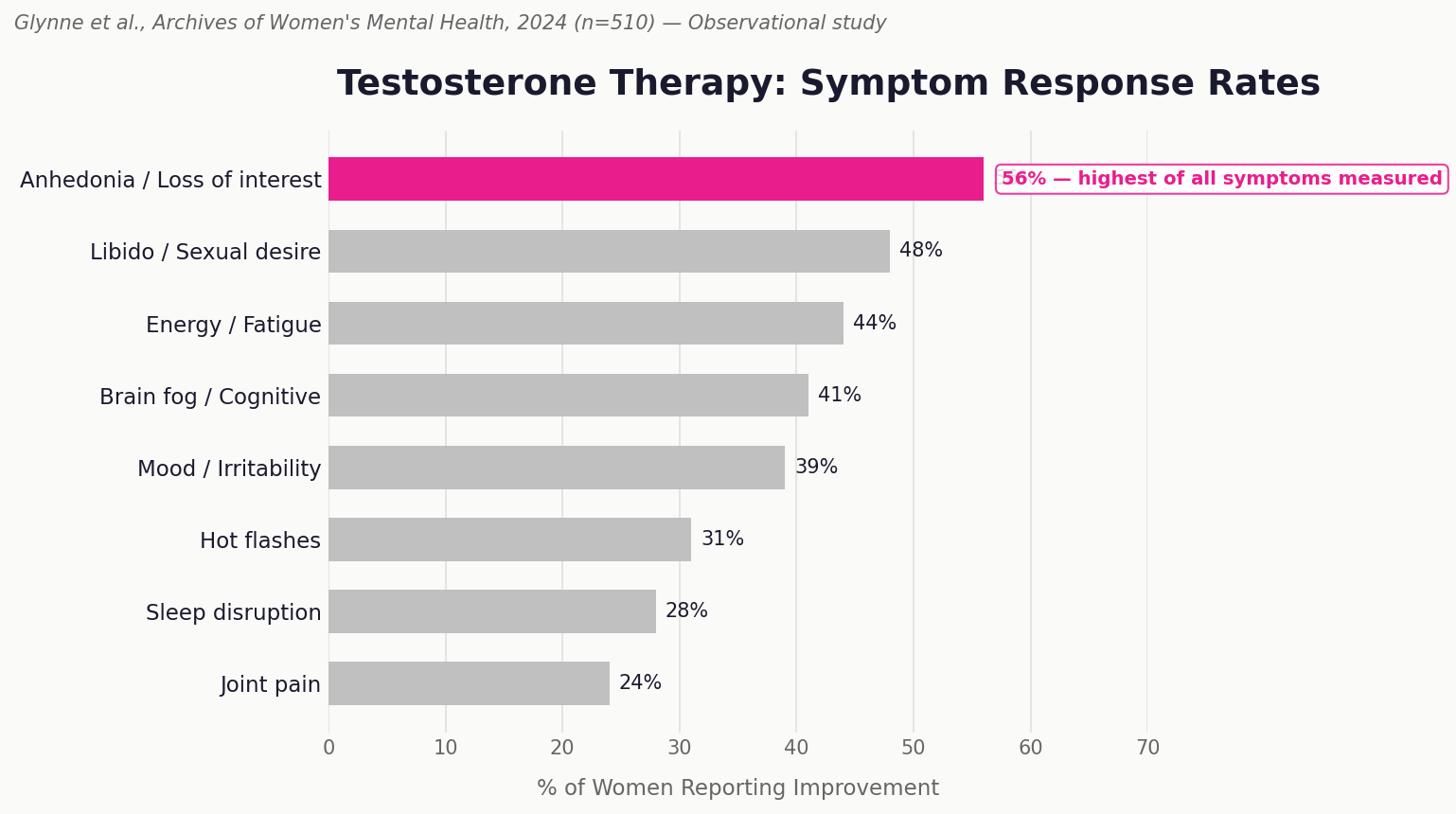 From Glynne et al., 2024, n=510. “Loss of interest in most things” was the single highest-responding symptom in the study. This chart is why the lack of a randomized trial is so frustrating.
Higher than libido, which is the symptom medicine usually mentions when it mentions testosterone at all. Higher than crying spells. Higher than every other symptom on the scale.
Fifty-six percent. The single most responsive symptom. In a dataset of over 500 women. And no randomized trial has ever made it a primary endpoint.
The RCTs that have “failed to show benefit” for testosterone on mood and motivation in women had serious design problems: immunoassay measurement error at female-range testosterone concentrations significant enough that the Endocrine Society called results below 150 ng/dL neither analytically nor clinically useful (meaning the dosing was essentially unmeasured), study durations of 8 to 12 weeks that conflated two very different timescales, and primary endpoints focused on sexual function rather than motivation.
Here’s the timescale distinction that the trials mostly missed: testosterone affects the dopamine system on two different horizons. The acute effect (increased dopamine release and receptor sensitivity) happens within 24 to 72 hours of a dose. That’s the “wanting” signal coming back online fast. The structural neuroplasticity changes (new receptor expression, axonal remodeling, changes to the VTA itself) take weeks to months to establish. When I describe feeling the difference within 48 hours of an injection, I’m describing the acute dopaminergic effect, not a placebo response. The studies that ran 12 weeks weren’t necessarily measuring at the right endpoint. They were looking for sexual function improvements in women who often weren’t deficient enough to show dramatic acute effects in a controlled lab setting, and they weren’t even looking at anhedonia. One 2020 trial found no significant difference from placebo at 8 weeks and didn’t control for SHBG, the binding protein that determines how much testosterone is actually available to brain tissue. The trials didn’t disprove the mechanism, but they also weren’t designed to test it. Those null findings were then cited as evidence that testosterone has no effect on motivation. That’s not what a null finding shows. It shows that if you don’t measure what you’re looking for, you won’t find it.
The dopaminergic mechanism is well-supported in pre-clinical research (in receptor binding studies, in animal models, in the VTA distribution data), and the observational clinical evidence is consistent with it. What has not yet happened is an adequately powered RCT with anhedonia as a primary endpoint in menopausal women. That is not the same as the mechanism being disproven. It means the right trial hasn’t been run. The clinical evidence is building. The RCTs are behind, not because the hypothesis is implausible, but because there’s no FDA-approved product for women’s testosterone, which means there’s no commercial incentive to fund the trials that would exist if there were.
My experience, specifically.
Thirty years on an antidepressant. It does its job. That part isn’t the story.
What I can now see, looking back, is that the flatness that came in through my 40s was not my antidepressant failing. My antidepressant was handling the serotonin system. What it couldn’t handle, because it wasn’t designed to, was the dopamine signal weakening as my testosterone declined.
I thought I’d become more realistic. I thought I’d outgrown the drive to start things. I thought this was what wisdom looked like.
When testosterone was restored, the flatness lifted. My antidepressant hadn’t changed. I hadn’t changed anything else. The dopamine-mediated wanting came back, and I recognized it not as something new, but as the thing that had been missing. The pull toward the work. The excitement to pursue an idea all the way to the end instead of organizing it into a folder and moving on. The appetite to bet on myself.
I can feel the difference with a precision that I didn’t expect. I know when my injection is overdue because the flatness starts coming back at the edges. Not dramatically. But a warmth dims. A hum goes quieter. When I get the injection, it returns within 48 hours. I am not describing a placebo effect. Testosterone enanthate has a half-life of approximately 4.5 days, which means by day 9 or 10 on a two-week schedule, I’m at a fraction of peak. The flatness at the edges has a cause and it has a schedule.
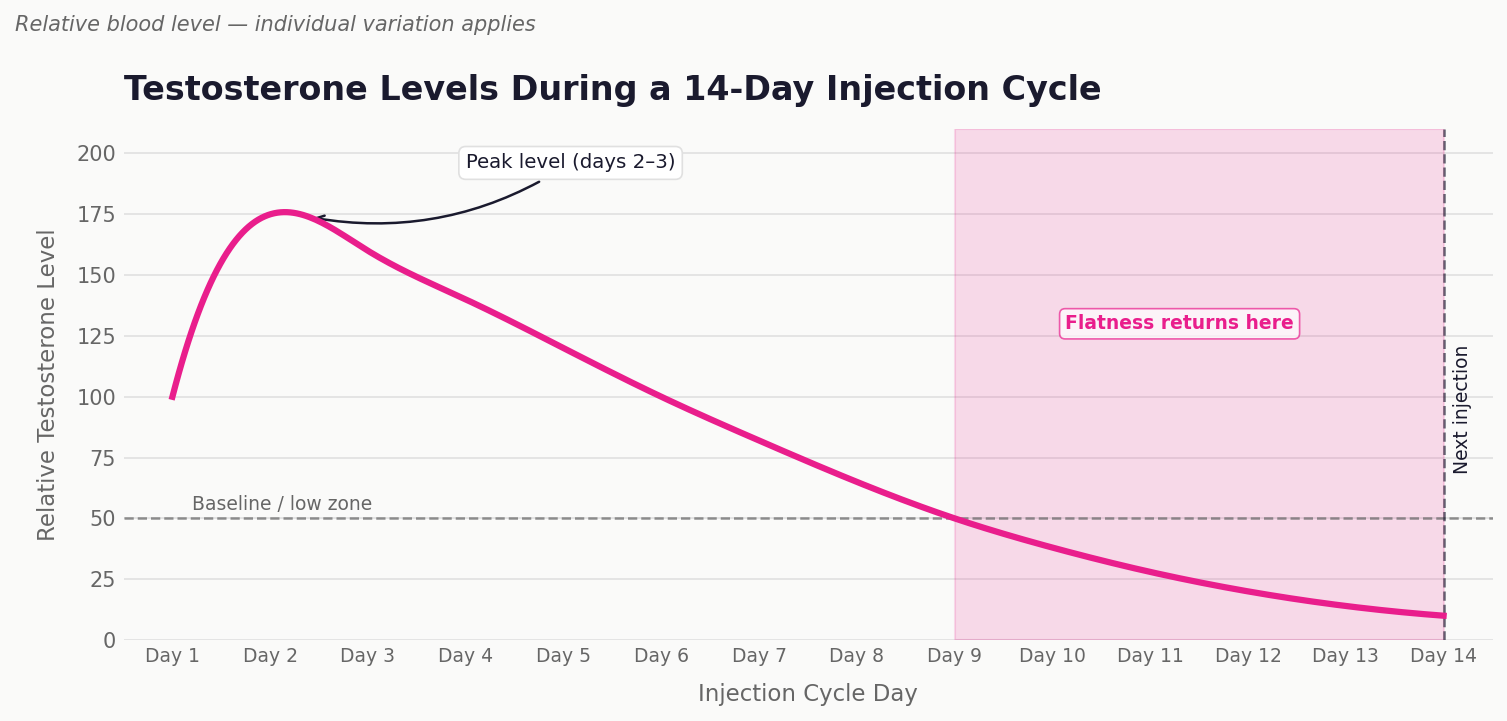 Testosterone enanthate PK curve over a standard two-week injection schedule. Peak lands around days 2 to 3. By days 9 to 10 you’re at a fraction of that. The “flatness at the edges” I describe is the trough, not mood dysregulation. Knowing this curve is how you understand what you’re feeling and when.
My antidepressant was never wrong. It was just solving a different problem. Knowing the difference matters. It’s the difference between adjusting a medication that’s working correctly for a decade and addressing the actual deficiency.
What to do if this sounds familiar.
If you’re on an antidepressant that is managing your depression and you still experience flatness, motivational deadness, loss of drive toward things you used to care about, this is worth investigating as a separate question. Not instead of your depression management. In addition to it.
Mary Claire Haver’s framing on testosterone testing is a strong foundation before you walk into any appointment.
🎙️ Follow Dr. Mary Claire Haver
Mary Claire Haver, MD. OB/GYN and menopause specialist who has spelled out why testosterone matters for women: why it’s undertested, what adequate levels actually look like, and why the standard “normal range” is not the same as optimal for a woman in perimenopause or beyond.
“Testosterone supplementation in physiologic ranges is absolutely helpful to females. Testosterone can help libido, energy, focus, and more during menopause. We lose, by the time we’re 50, about 50% of our highest testosterone levels from when we were younger.”
📸 Instagram: @drmaryclairehaver 📗 Book: The New Menopause
Ask specifically about testosterone. Not just “hormones.” Testosterone. Ask for:
- Total testosterone
- Free testosterone by equilibrium dialysis, the gold-standard method. Not calculated free T, not an analog assay. The method matters: the Endocrine Society has formally stated that direct immunoassays at female-range testosterone concentrations are “neither analytically nor clinically useful,” and independent testing has found mean bias up to 200% compared to mass spectrometry. [Rosner et al., J Clin Endocrinol Metab, 2007; Vesper et al., Asian J Androl, 2014] When you ask for this test, give your doctor the specific order: LabCorp test 500726 (Testosterone, Free, Mass Spectrometry/Equilibrium Dialysis) or Quest test 36170 (Testosterone, Free (Dialysis) and Total, MS). This test code isn’t widely known, but it exists, it’s covered at most major labs, and it gives you an accurate number instead of a guess.
- SHBG, Sex Hormone-Binding Globulin, the protein that binds testosterone and makes it biologically unavailable. High SHBG, which is common in women on oral estrogen or certain medications, can tank your free testosterone even if your total looks normal on paper.
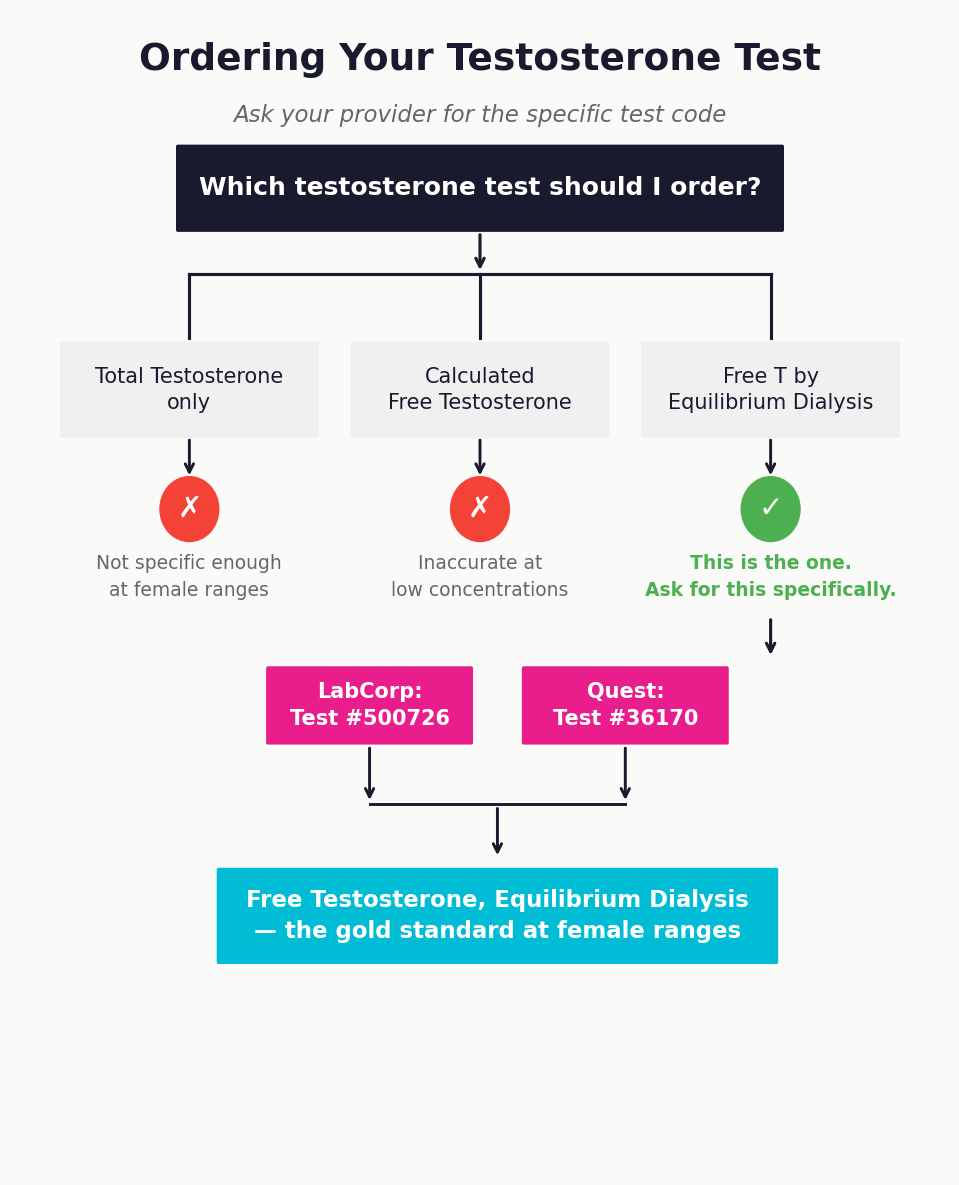 How to read your results. Total T tells you the headline number. Free T by equilibrium dialysis tells you what’s actually available to your tissues. SHBG tells you why they might not match. LabCorp #500726 or Quest #36170 is the test to ask for, by name, by number.
A note on prescribing. Testosterone therapy for mood, motivation, and anhedonia in women is currently off-label in the US. There is no FDA-approved testosterone product for women in any indication. This is one reason the testing and prescribing conversation works better with a menopause specialist than a general practitioner. It also means your prescriber will be working outside a standard protocol, which is precisely why measurement precision (equilibrium dialysis rather than immunoassay) matters: when there are no established dosing guidelines, an accurate baseline number is the only thing both you and your prescriber have to navigate from.
Be specific with your prescriber about what you’re describing. The word “libido” will route you to a sexual function conversation. That’s not the conversation. Say: “I’m not talking about libido. I’m talking about anhedonia, loss of drive, loss of motivation to initiate things I used to care about. I want to explore whether testosterone deficiency is contributing to this.” Name the word. Make it specific. Give your doctor a problem they can investigate rather than a vague complaint they can dismiss as aging.
For Black women specifically, the dismissal problem runs deeper and in both directions. In psychiatry, anhedonia in Black patients is systematically undertreated: studies consistently show Black women are less likely to have their mood symptoms taken seriously and more likely to have them attributed to external circumstances rather than biology. In hormone medicine, testosterone is rarely offered to Black women, and the WHI’s “HRT causes cancer” headlines reinforced avoidance in a community that already had reason to distrust the medical system. The practical consequence: if you’re a Black woman and you bring this to your doctor, you may need to be more explicit, more persistent, and more prepared to ask for a second opinion. The Menopause Society provider finder is still the right starting point, but go in knowing that you may need to advocate harder, and that the dismissal, if it comes, is not evidence that the question is wrong.
For Latinas navigating this in a clinical environment where the menopause conversation is still 10 to 20 years behind, there are additional layers: cultural framing that treats emotional flatness as a natural consequence of a busy life rather than a clinical symptom, providers who have had no exposure to testosterone prescribing for women, and in some countries a laboratory infrastructure that may not have equilibrium dialysis available locally. The principle is the same. The advocacy often looks different.
If this resonates, the labs are the concrete next step. You’re not looking for a verdict. You’re looking for information that tells you whether there’s a gap worth addressing. If the labs show a deficiency, that’s a solvable problem. If they show adequate levels, that rules out this particular mechanism and points toward different questions. Message your doctor’s office through your patient portal today and request these three labs explicitly. Copy this language if it helps: “I’d like to test my hormone levels with a focus on testosterone, specifically total testosterone, free testosterone by equilibrium dialysis (not calculated, not analog assay), and SHBG.” If your doctor doesn’t know what equilibrium dialysis is, that’s useful information. It means your next step is finding a menopause specialist, not adjusting the medication that’s already working. The Menopause Society has a provider finder at menopause.org, filter for providers who list testosterone as a specialty. A psychiatrist knows the serotonin system. A menopause specialist knows the testosterone system. You need someone who can see both charts at once.
If access to a menopause specialist is a barrier (geographic, insurance, or financial), the lab request can still be initiated through your primary care physician. The test codes work at major commercial labs nationwide, and the results are the starting point for a specialist referral if your current provider isn’t comfortable proceeding.
Two systems, two tools.
The antidepressant is doing its job. It was always doing its job. The problem is that it was doing the serotonin job while the dopamine system was running on low testosterone, and nobody connected those two facts.
For women who’ve spent years adjusting doses, switching medications, wondering why they still feel flat when the depression is technically managed, this distinction decides whether the next 10 years go to the wrong question or the right answer.
The flatness isn’t an inevitable feature of getting older. In a lot of cases, it’s a deficiency in a specific, testable, correctable system. And when you know which system, you can address it directly, without touching the thing that’s already working.
One more reason the labs matter beyond motivation: the same testosterone deficiency that quiets your drive also plays a role in muscle maintenance, bone density, and metabolic function. Emerging evidence suggests these structural effects are real, even if the clinical picture for mood and motivation is further along. [Davis SR, et al. J Clin Endocrinol Metab. 2019;104(10):4660-4666. doi:10.1210/jc.2019-01603]
The motivational symptoms are often the first thing women notice, but they’re not the only system running low. Getting tested addresses more than one problem at once.
 Testosterone doesn’t just affect libido. It plays a role in brain function, muscle maintenance, bone density, cardiovascular health, and metabolic regulation. The motivation symptoms are usually what brings women to investigate, but the labs address a much wider picture.
Go get the labs. Ask the right question. And if your antidepressant is working, don’t let anyone tell you it isn’t, just because something else is also wrong.
This article is part of the SmartStrongAlive Testosterone Series, a deep dive into the hormone medicine forgot to tell women about.
In this series:
- Part 1 (you are here): The flatness my antidepressant couldn’t fix, and the hormone that did
- Part 2 (coming next): The Hormone Nobody Told You About. Zero FDA approvals, 22 years of regulatory failure, and why your labs might be lying to you
- Part 3: How to actually get testosterone therapy (delivery methods, finding a provider, what to monitor)
- Reading list: The books that changed how I understand my own body
If this resonated, Part 2 is the bigger story, the political and scientific failure that kept this hormone from millions of women.
Sources
-
Glynne S, Kamal A, Kamel AM, Reisel D, Newson L. Effect of transdermal testosterone therapy on mood and cognitive symptoms in peri- and postmenopausal women: a pilot study. Archives of Women’s Mental Health. 2024 Sep 16;28(3):541-550. doi:10.1007/s00737-024-01513-6. UK observational cohort, n=510; loss of interest in most things had the highest response rate of all symptoms at 56%.
-
Rosner W, Auchus RJ, Azziz R, Sluss PM, Raff H. Utility, Limitations, and Pitfalls in Measuring Testosterone: An Endocrine Society Position Statement. J Clin Endocrinol Metab. 2007 Feb;92(2):405-413. doi:10.1210/jc.2006-1864. PMID: 17090633. Endocrine Society position: direct immunoassays below 150 ng/dL are neither analytically nor clinically useful; equilibrium dialysis is the reference standard.
-
Vesper HW, Botelho JC, Wang Y. Challenges and improvements in testosterone and estradiol testing. Asian J Androl. 2014;16(2):178-184. doi:10.4103/1008-682X.122338. PMID: 24407184. Documents mean bias of 5%-220% for immunoassays vs. mass spectrometry at female-range testosterone concentrations.
Annette Thompson is 57, the founder of adoption.com, and a menopause advocate writing about evidence-based women’s health.